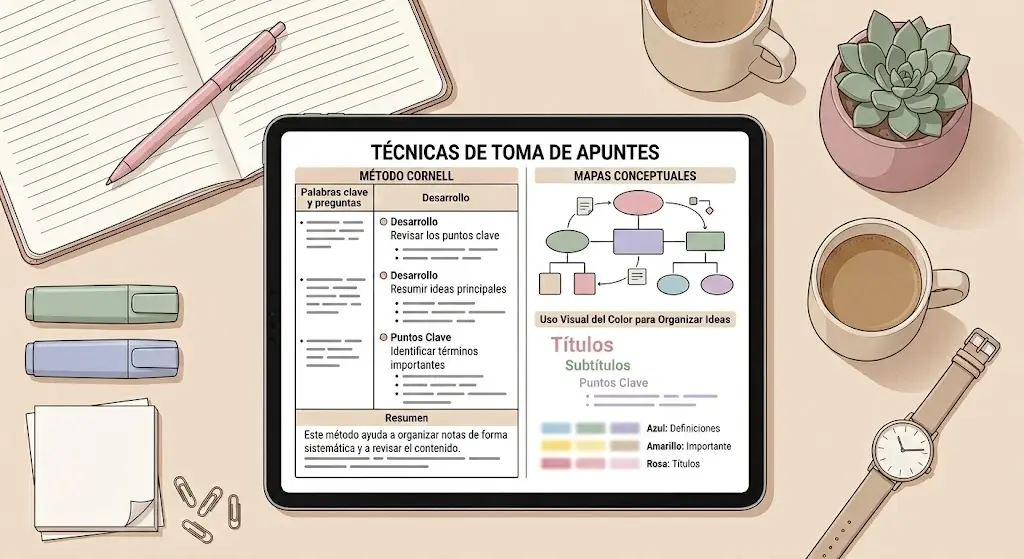
Taking good notes is fundamental to understanding and remembering what you learn, but copying down dictation is not note-taking: it is transcribing. And you transcribe just as well whether or not your head is in the room. The techniques that work are the ones that organize information actively and force you to process it as you write. Let's look at the three strongest ones.
Key takeaways
- Good notes are written to be reviewed, not to be owned.
- Rephrasing in your own words is what turns noting into learning.
- Cornell, sketchnoting, and schematic notes suit different content.
- Notes are only worth it once they end up as questions.
Schematic notes: the QEC format
Schematic note-taking consists of organizing information with key questions, diagrams, or lists instead of transcribing long text. The most useful model in this approach is the QEC format (Question, Evidence, Conclusion).
For each section or main argument you pose a relevant question that captures the core of the content, gather the evidence that supports the answer (data, examples, facts), and write down the conclusion, the synthesis that answers that question. When you finish you have a kind of study guide with every key point structured.
This approach takes advantage of active listening and reading. Instead of copying entire paragraphs, you extract concepts in your own formulation, and writing the question and conclusion in your own words makes you process the information far more deeply.
Advantages of schematic notes
- Order and clarity: structuring into questions and answers makes key ideas instantly visible.
- Greater efficiency: you go straight to what matters, without copying filler.
- Better understanding: formulating questions forces you to genuinely understand the content.
- Ready-to-use review: you end up with a bank of likely exam questions at no extra cost.
When they fail: they are useless if you copy like a robot, ask questions that are too broad, or write answers you do not understand. If there is no reflection, there is no learning; that is pretty highlighting, not studying.
Tips to do them well
- Listen or read first: do not write on the first pass. Identify the main ideas, then formulate the relevant questions.
- Ask good questions: each one should capture a key point. "How does evaporation happen and what effects does it have?" works; "the water cycle" does not.
- Write in your own words: keywords and short phrases instead of copied paragraphs.
- Use arrows and diagrams: link question and answer visually; a simple sketch clarifies relationships that prose hides.
- Review early: spend a few minutes after class filling the gaps, while the concepts are still fresh.
Ultimately, it is not about transcribing but about having a dialogue with yourself: well-thought-out questions + clear answers = real learning.
Visual notes (sketchnoting)
Sketchnotes combine short text with simple drawings (icons, arrows, diagrams) to represent information graphically. You do not need to draw well: clear doodles are enough.
They are based on Visual Thinking, which exploits the fact that the brain remembers better what it associates with images. Turning ideas into drawings works the verbal and visual parts of your brain at once, which increases attention and makes autopilot copying impossible. When you review, those drawings act as mental anchors.
Benefits of sketchnoting
- Increases concentration: you cannot draw a concept and be distracted at the same time.
- Improves memory: combining text and image creates stronger connections, and each icon acts as an extra retrieval cue.
- Forces synthesis: to draw a complex idea you first have to reduce it to its essentials.
- Gives the big picture: a good sketchnote shows the structure of the topic at a glance.
- Makes studying more enjoyable: reviewing colourful outlines is less tiring than rereading plain text, and that sustains motivation.
When to use sketchnoting
It is especially useful in subjects with a lot of conceptual content: social sciences, humanities, or complex ideas. It also fits very well when studying with videos or podcasts, because you can pause and draw calmly.
In highly numerical subjects, such as step-by-step mathematics, it is less practical: drawing does not replace reasoning. In short: perfect for ideas and concepts, complementary for calculations.
Practical tips:
- No perfectionism: reuse the same symbols and do not fuss over the linework.
- Few colours: 2–3 are enough, preferably soft tones. You can expand on this in our article on how to highlight well.
- Text + drawing: add keywords next to each icon; do not replace everything with images.
- Mind the path: use arrows and boxes so the content follows a logical order.
- Go for the essential: represent only the ideas that help you understand the whole.
The Cornell method
The Cornell method is the classic system for taking notes in class. It consists of dividing the page into three zones before you start:
- Notes column (right): about 2/3 of the page. This is where you write during class: definitions, examples, dates, equations.
- Cue column (left): a narrow 6–7 cm strip. It is filled in after class with keywords, questions, or cues aligned with the adjacent paragraph.
- Summary (bottom): a 5–6 cm strip where you write, at the end of class or the next day, a paragraph with the most important ideas.
During class you take notes normally in the right column: short sentences, formulas, bullets, without trying to capture every word. As soon as you can, fill in the left column and the summary.
Advantages of the Cornell method
- Encourages active listening: you know you will have to write questions later, so you listen to understand rather than to copy.
- Self-explanatory material: notes, questions, and summary live on a single page.
- Efficient review: cover the notes column and answer the cues out loud. That is already active recall.
- Built-in summary: synthesizing right after class consolidates the content while it is still fresh.
Among the disadvantages, count on extra time after each class and a fair amount of discipline: skip the follow-up work and the method loses nearly all its value.
Conclusion
There is no single perfect way to take notes, but what always works is studying actively. All three techniques force you to filter, synthesize, and reorganize information, which is exactly what does not happen when you highlight or copy.
That said, excellent notes are still passive material until you turn them into questions. That last step is the one almost nobody takes, because by hand it costs hours.
At Selectiva App you can upload your notes and turn them automatically into quizzes, flashcards, and outlines, so the work you already did in class becomes active recall and spaced repetition practice.
Do not make pretty notes: make notes that test you.
Frequently asked questions
Which note-taking method is best?
It depends on the content: Cornell for lecture-based classes, sketchnoting for conceptual topics, and schematic notes for dense material you will review through questions.
Is it better to take notes by hand or on a laptop?
Handwriting is slower, which forces you to summarize and rephrase, and that helps comprehension. A laptop wins on speed and tidiness but makes it easy to copy without processing.
How long should I spend reviewing my notes?
About 10 minutes the same day to fill gaps, plus a short review after 24 hours. That is when you recover the most memory per minute invested.
Should I write down everything the teacher says?
No. Capturing every word prevents you from processing the content. Record concepts, relationships, and key examples, and leave space to complete later.
Study better with your own notes
Upload your PDFs and Selectiva turns them into summaries, quizzes and flashcards in seconds.