Taking good notes is fundamental to understanding and remembering what you learn. It is not enough to write without criteria or underline mechanically. There are study techniques that organize information actively and help us process it instead of just copying it. Let's look at some of them.
Outlining and Schematic Note-Taking
Schematic note-taking consists of organizing information with key questions, graphics, or lists, rather than transcribing long text. A very useful model within this approach is the PECc format (Point, Evidence, Conclusion). For each section or main argument, you pose a relevant QUESTION (a statement or problem that captures the core of the content). Then you gather the necessary EVIDENCE (data, examples, or facts that support the answer) and finally write down the CONCLUSION, that is, the explanation or synthesis that answers the posed question. By working this way, you end up with a kind of "study guide" with all the key points structured.
This approach takes advantage of active listening and reading. Instead of copying entire paragraphs, you focus on extracting concepts in your own formulation. By writing the question and the conclusion in your own words, you process the information in your brain more deeply. Additionally, the PEC format forces you to organize information logically.
Advantages of schematic notes
- Order and clarity: By structuring into questions and answers, you instantly identify key ideas and review faster.
- Greater efficiency: You go straight to what's important, without copying unnecessary filler.
- Better understanding: Formulating questions forces you to truly understand the content and reinforces memory by isolating essential ideas.
- Ready-to-use review: You end up with a bank of possible exam questions and short answers, perfect for studying without extra effort.
When they can fail: They are useless if you spend your time copying like a robot, ask questions that are too general, or write answers without understanding what you are putting down. If there is no reflection, there is no learning; that is pretty underlining, not studying.
Tips for making effective schematic notes
- Read or listen first: Before writing anything down, make sure you have a general overview of the topic. Identify the titles or main ideas. On the first pass, don't write; then go back to formulate the most relevant questions.
- Formulate good questions: Each question should reflect a key point. For example, if the class is about the water cycle, you could ask “How does evaporation occur and what effects does it have?” instead of something too broad. Good questions guide your attention toward the essential.
- Write in your own words: When noting evidence and conclusions, be brief and clear. Use keywords or short phrases instead of copying long paragraphs. This forces you to process the content.
- Use outlines and diagrams: Don't limit yourself to writing text. You can use arrows, bullets, or brackets to link question and answer. Even a small drawing or diagram (for example, a simple graph) can clarify important relationships.
- Note in the margin or with symbols: Next to each point, jot down the most important information with bullets or different colors, or draw an icon that reminds you of the idea. This reinforces visual memory and makes the outline easier to review.
- Review and complete early: After the class or reading, spend a few minutes reviewing your outline. If any answer was left incomplete, look for it in your original notes or the book. The sooner you fill those gaps, the fresher the concepts will be in your mind.
Ultimately, it’s not about transcribing, but about dialoguing with yourself: well-thought-out questions + clear answers = real learning.
Visual Note-Taking (Sketchnoting)
Visual notes or sketchnotes combine short text with simple drawings (icons, arrows, diagrams) to represent information graphically. You don't need to know how to draw well: clear doodles are enough.
They are based on Visual Thinking, which takes advantage of the fact that the brain remembers better what it associates with images. By listening and transforming ideas into drawings, you work both the verbal and visual parts of the brain at the same time, which increases attention and prevents passive copying.
Furthermore, when reviewing, the drawings act as mental “anchors” that make it easier to remember concepts in more detail. In short: less plain text and more memory thanks to visuals.
Benefits of sketchnoting
- Increases concentration: Drawing while taking notes requires you to be fully present. You can't be distracted because you are transforming every concept into an image. This prevents the mental disconnection typical of copying without understanding.
- Improves memory: By combining text and drawing, you create stronger connections. The act of capturing emotions, humor, or personal symbols in your notes helps fix them better. Each icon or color functions as an additional memory that facilitates later recall.
- Synthesizes information: You need to reduce complex ideas to their basic elements before drawing them. This trains the ability to summarize: you must identify the essential to represent it simply.
- Allows you to see the big picture: A well-made sketchnote usually shows the structure of the talk or topic at a glance. You can use flowcharts, mind maps, or visual tables that group related concepts. This way you understand the “global image” and the relationships between parts.
- More enjoyable and creative study: Drawing makes studying less monotonous. Reviewing notes with colors, diagrams, or caricatures is more pleasant than reading simple text. This increases motivation and interest in studying, especially in the long term.
- Reinforces creativity: The act of drawing stimulates the imagination. Over time you develop your own style of icons and shapes that serve you for any subject, which can also inspire you when studying other topics.
When to use sketchnoting
Sketchnoting is especially useful in classes or talks with a lot of conceptual content: social sciences, humanities, business presentations, or complex ideas. It also fits very well in brainstorming sessions and when studying with videos or podcasts, because you can pause and draw calmly.
In highly numerical subjects, such as step-by-step mathematics, it is less practical, as drawing does not replace reasoning. Even so, it can be used to highlight formulas or key concepts with simple diagrams. In short: perfect for ideas and concepts; complementary (but not central) in calculations.
Practical tips for good visual notes:
- No perfectionism: Use simple drawings and repeat the same symbols to avoid wasting time.
- Practice beforehand: Start with simple sketches and try out basic lettering and icons until you feel comfortable.
- Few and well-chosen colors: 2–3 are enough; too many are distracting. Better to use soft tones that don't tire the eyes during review → You can expand on this technique in our article on how to underline well
- Text + drawing: Don't replace everything with images; add keywords next to each icon.
- Mind the organization: Use arrows, boxes, or visual maps so the content follows a logical path.
- Go for the essential: Don't draw every detail; represent only the important ideas that help you understand the whole.
The Cornell Method
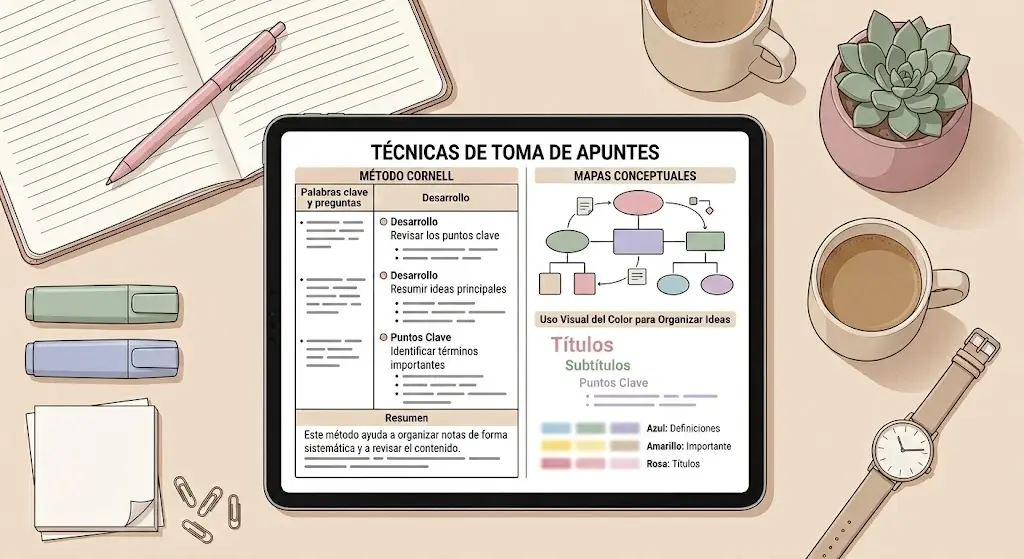
The Cornell method is a classic system for taking notes in class. It consists of dividing the sheet into well-defined sections to structure information in an organized way and facilitate review. In its basic form, you divide the page like this:
- Note-Taking Column (right side): where you normally write everything the teacher says during class. Dates, definitions, examples, equations, etc., go here. It should take up about 2/3 of the sheet.
- Cue or Key Ideas Column (left side): a narrow column (about 6–7 cm) in the left margin. In it, when reviewing after class, you write down keywords, questions, or cues that help recall what is in the notes column. Each cue should correspond to the adjacent line or paragraph in the notes column.
- Summary (bottom part): at the bottom of the page, you draw a horizontal strip about 5–6 cm high. In that space, you will write a brief summary of the most important ideas after the class (or the next day).
During class, you take notes normally in the right column. Try to make a brief but complete record: short sentences, formulas, bullets. Do not try to write everything word for word, but rather the essential concepts. Immediately after class or as soon as you can, fill in the left column and the summary.
Advantages of the Cornell method
- Facilitates active listening: Knowing that you will later have to create questions, you make an effort to understand the lesson while taking it. You don't limit yourself to passive transcription.
- Better organization: Having notes, questions, and a summary on a single sheet makes your material self-explanatory. Everything relevant from a class is structured and ready to consult.
- Efficient review: The key ideas column serves to self-assess. For example, cover the notes with a sheet and try to answer each question out loud using only the cue column. This retrieval practice reinforces memory.
- Integrated summary: Writing the summary forces you to synthesize what you have learned. That short final paragraph consolidates knowledge right after class when it is still fresh. Then, when you study, that summary will remind you of the core of the topic at a glance.
- Customizable: You can adapt the size of each section according to what you need (more space for notes or more for cues). Over time you will develop your personal style within this scheme.
Among the disadvantages, keep in mind that this method requires more time because completing questions and summaries involves extra work after each class; in very long or dense sessions, it can be tedious to fill everything out, so it is advisable to focus on key ideas and leave secondary ones for later; additionally, it requires discipline, as if you don't do the subsequent review or complete the pending parts, the method loses much of its effectiveness.
How to do Cornell correctly
- Divide the page well: Before starting class, draw the lines that separate the sections. It is worth noting that some use four areas (with a top header for the topic or date), but the essential parts are the right column (Notes), the left column (Cues), and the bottom summary.
- Note key ideas while listening: During class, write only the essentials in the wide column. Use bullets, outlines, or boxes if you prefer, but keep the most relevant information there.
- Fill the cue column after class: Reread your notes and extract key concepts. Write them as questions, keywords, or short cues in the left column. Make sure to follow the same order as your notes so they match up.
- Write the final summary: Use your own words to write a 4–6 line paragraph with the most important parts of the session. This summary is your own text, so make it clear and concise.
- Review regularly: Every so often (for example, weekly) look back at your Cornell notes. Try to mentally answer the questions in the Cue column without looking at the answers. This activates your memory and strengthens what you have learned.
Conclusion
There is no single perfect way to take notes, but what always works is studying actively. Techniques like schematic note-taking, sketchnoting, or the Cornell method force you to filter, synthesize, and reorganize information. This is very different from simply underlining passively, which as we remember has a very limited effect on its own. Instead, when you transform your notes with questions, drawings, or fixed structures, you turn the material into something more meaningful. When reviewing, a clear outline, a striking drawing, or good questions make it easier for your brain to retrieve important information.
The ideal is to use these techniques combined with other study strategies. For example, after taking schematic or Cornell notes, you can turn them into flashcards to practice active recall.
At Selectiva App, we understand the importance of this scientific approach to studying. That's why on the platform you can organize your notes and summaries, and above all, reinforce what you've studied through practical exercises based on active recall and spaced repetition. It's not just about making pretty notes, but about turning them into real and lasting learning. If you want to make the most of your notes and study more effectively, we encourage you to try Selectiva App and see the difference in your performance. Study smart, not just harder, and take advantage of every note-taking technique!