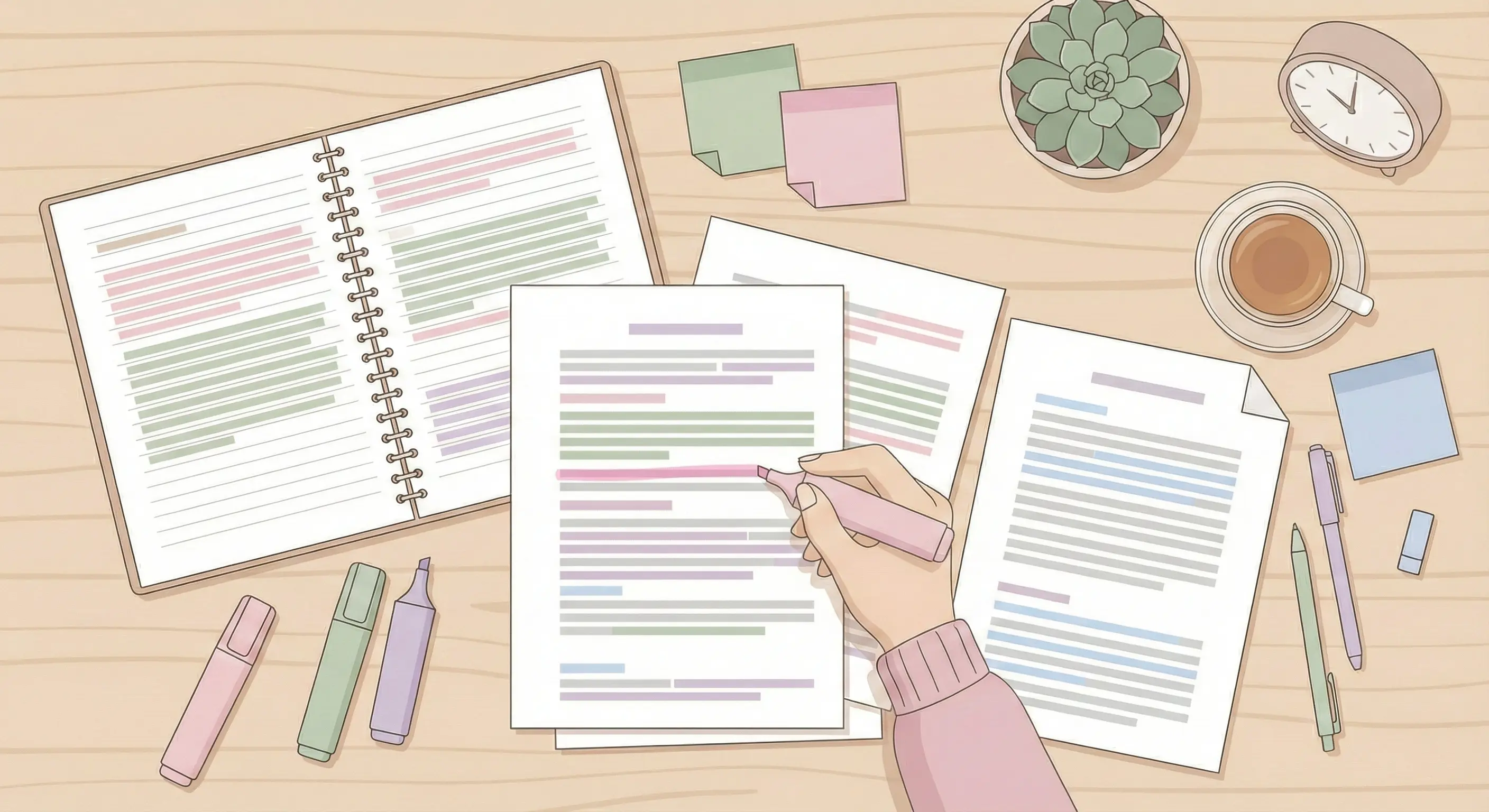
Highlighting is the most popular study technique among students and, probably, the most overrated one. The idea is simple: mark the key ideas to make reviewing easier. However, science warns that highlighting on its own contributes very little in the long term: people assume that marking text guarantees learning, and several scientific reviews indicate the opposite.
That does not mean you should throw the highlighter away. It means you need to know what it can and cannot do for you.
Key takeaways
- Highlighting is not studying: it is preparing the material to be studied.
- The more you highlight, the less the highlights stand out.
- Its biggest risk is the false sense of mastery.
- It only pays off when followed by active recall.
How highlighting works: cognitive bases
Highlighting is visual encoding: you mark fragments of text and draw attention to them. This exploits the isolation effect (or Von Restorff effect), by which information that "stands out" from the rest is remembered better. It also forces you to focus briefly on each marked idea.
The problem is that this effort is usually superficial. In other words, highlighting is passive: without later reflection, it amounts to knowing that something is important, not to understanding it.
Benefits of highlighting: why might it help?
Although it is a limited technique, it can be useful when used with judgement:
- Focused attention: marking what matters directs your eyes to the essentials and speeds up review, without rereading the whole paragraph.
- Visual distinctiveness: highlighted elements stand out against normal text, and the brain tends to notice and retain whatever breaks uniformity.
- A basis for outlines and summaries: good highlighting identifies the concepts you will later organize with more active methods.
Notice that none of the three advantages is "learning": all three are advantages of preparation.
When it is a waste of time
Highlighting without a strategy is practically useless. These are the mistakes the research documents:
- Excessive highlighting: when you mark full sentences, everything stands out equally and the Von Restorff effect cancels out. If your page looks like a traffic light, there is no signal left.
- Shallow studying: highlighting becomes mechanical when it is not paired with reflection, turning into a low-effort task that only feels like studying.
- False sense of mastery: after highlighting a paragraph, many students believe they have mastered it. It is the same "illusion of knowledge" that ruins rereading.
- Opportunity cost: every hour with the highlighter is an hour not spent on active recall or spaced review, which are the high-impact techniques.
- Inappropriate colours: loud tones and too many colours strain your eyes without adding anything. Better few colours, soft, and with a logical code.
How to highlight well
To make the most of it without wasting your time, follow these five rules:
- Read before highlighting: mark nothing on the first read. First understand the full text, then do a second pass to highlight only the essentials.
- Mark minimal key ideas: limit each highlight to a few words or central phrases. Never entire sentences.
- Use colours with purpose: build your own code (one colour for concepts, another for definitions, another for dates or authors). Pastel tones and no more than 3–4 colours.
- Annotate in the margin: pair highlights with brief notes or symbols (arrows, brackets, numbers) that clarify relationships between concepts. This forces active processing.
- Do not rely on sight alone: after highlighting, turn what you marked into a question and answer it without looking. This active recall step is what turns a visual mark into learning.
Combine highlighting with other techniques
Highlighting performs best as the first piece of a system, not as the whole system:
- Active recall: generate practice questions from what you highlighted and test yourself.
- Spaced repetition: revisit the highlighted material at scheduled intervals.
- Summarizing and outlining: use the highlighted material to build summaries or concept maps, as we explain in our note-taking guide.
- Self-explanation: say out loud what you highlighted and why it matters.
That jump from marking to practice is exactly the step people skip, because setting it up by hand takes time. At Selectiva App you can upload the material you have already worked through and turn it straight into quizzes, flashcards, and outlines, so highlighting stops being the end of your study session and becomes the beginning.
Conclusion
Highlighting is not a panacea, but it is not useless when used wisely. Research agrees that on its own it contributes very little to long-term retention; used correctly, it saves review time and guides your study.
The rule is simple: highlight to decide what you are going to study, not to study it.
Marking the text is not learning it.
Frequently asked questions
Is highlighting your notes actually useful?
It is useful as a preliminary step: it helps you locate what matters and prepare summaries or questions. As your only study technique, the evidence says it contributes very little.
How much text should I highlight?
A few words per idea. If you mark full sentences or more than 20% of the page, you lose the isolation effect that makes highlighting worthwhile.
How many colours should I use?
Between two and four, always with a fixed code and in soft tones. More colours tire your eyes and complicate review instead of easing it.
What should I do after highlighting?
Turn what you highlighted into questions and answer them without looking. That active recall step is what converts marking into real memory.
Study better with your own notes
Upload your PDFs and Selectiva turns them into summaries, quizzes and flashcards in seconds.