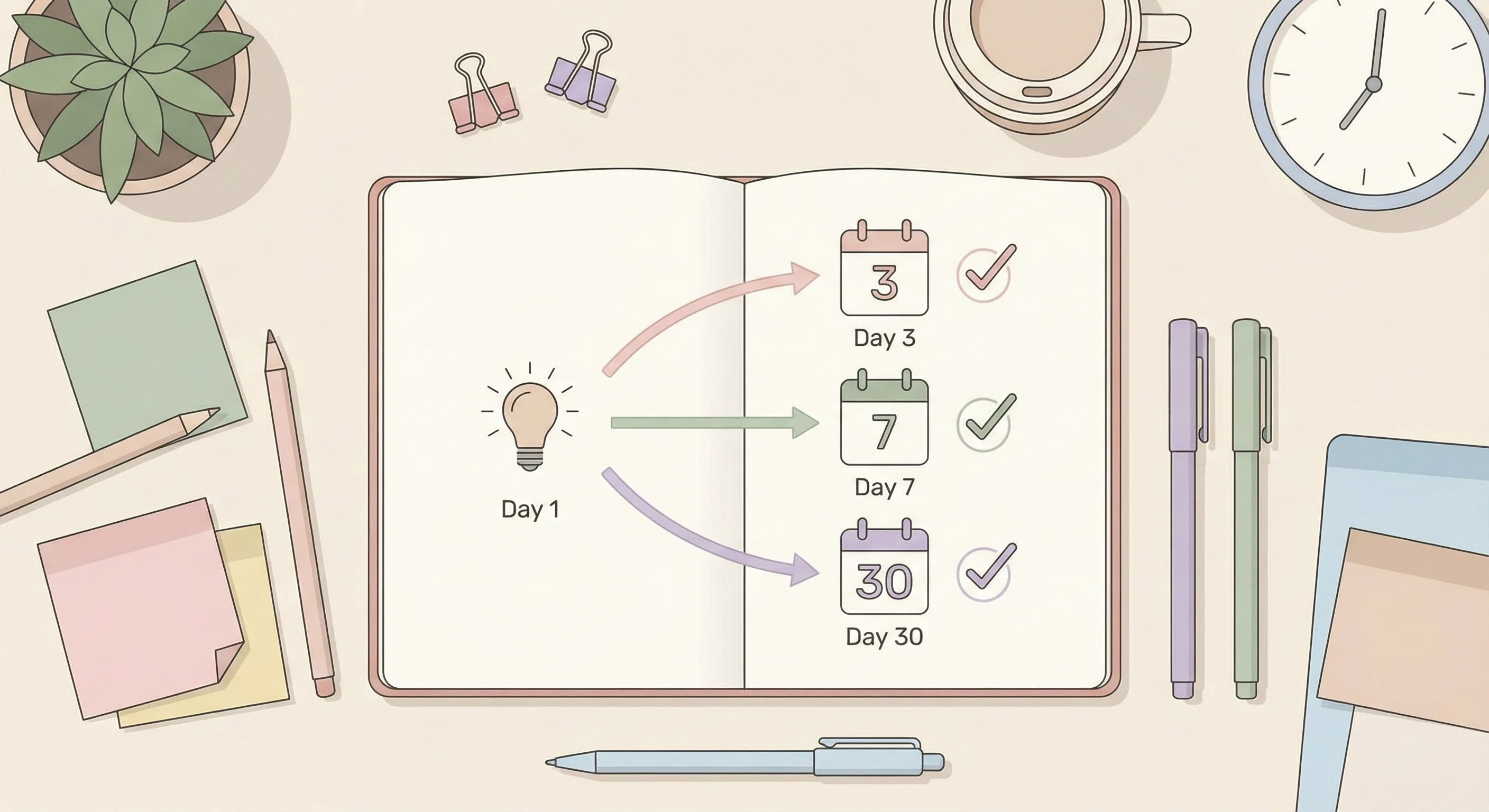
You study a topic on Sunday, you have it down cold, and by Thursday it rings no bells. That is not your memory failing: you studied it all at once. Spaced repetition fixes exactly that problem, and it is not a TikTok trend — it is backed by decades of memory research. In this guide you will see how it works, how to build it into your routine, and which mistakes ruin it.
Key takeaways
- Reviews spread over time retain far more than studying everything at once.
- The best moment to review is right before you forget the content.
- Every successful review lets you stretch the next interval.
- It works for any subject, but only if you are consistent.
How does spaced repetition work? The science behind the method
The method rests on the forgetting curve, the phenomenon described by psychologist Hermann Ebbinghaus in the 19th century: information fades from memory exponentially from the moment you stop using it.
The key is reviewing just before you forget. Every successful review strengthens the neural connections and flattens the slope of that curve, which lets the intervals between sessions grow longer and longer. It is like reinforcing a wall: you do not need to rebuild it every day, only to prop it up at the right moment.
Three scientific principles hold it up:
- Spacing effect: we learn more when sessions are distributed over time than when they pile up.
- Retrieval practice: actively recalling fixes knowledge far better than rereading.
- Optimal intervals: there is an ideal point to review, neither so early that it is useless nor so late that it is already gone.
👉 You can dig into the mechanics of forgetting in our article on the forgetting curve.
Benefits of spaced repetition: why you should implement it
Efficient long-term memorization
Spaced repetition turns a brutal memorization process into something systematic and predictable: little by little you get used to the concepts and end up internalizing them, instead of holding them up by force for a week.
Significant time savings
By focusing on what you are about to forget and skipping what you have already mastered, you cut total study time considerably. You do not study less because you try less, but because you stop reviewing what you already know.
Versatile application
This method works across disciplines:
- Languages and vocabulary
- Medical, law, or engineering exams
- Scientific or mathematical concepts
- Historical facts and dates
Less academic stress
Distributing sessions helps you avoid burnout. You arrive at each review with a clear head and without the feeling of chasing the syllabus, which translates into more motivation and better performance.
How to implement spaced repetition in your routine
Manual system: the Leitner method
The most accessible system runs on physical cards and boxes:
- Create the cards: one question per card, with the answer on the back.
- Sort them by difficulty: one box for the ones you miss, one for the ones you hesitate on, one for the ones you have mastered.
- Assign frequencies: the hard box is reviewed daily; the mastered one, every week or two.
- Move the cards: get it right and it moves up a box; get it wrong and it goes back to the first.
Specialized software
Preparing and scheduling all of that by hand eats exactly the time the technique is meant to save you. This is where technology stops being a distraction and becomes a tool.
At Selectiva App we built a platform that applies these principles for you. Based on the deadline you set, the algorithm generates an optimal learning path and decides what to review each day:
- Flashcards with automatic intervals: they show you the card right before you forget it.
- Quizzes from your own notes: they turn your syllabus into retrieval practice.
- Summaries and outlines: to rebuild the big picture before each review.
You do not just get a tool, but a complete system that adapts to you and removes the heaviest part: deciding when to review each thing.
Common mistakes and how to avoid them
1. Creating poor quality cards
- Mistake: questions that are too simple, or so long they contain half a lesson.
- Solution: one idea per card, phrased so it demands thinking, not recognizing.
2. Lack of consistency
- Mistake: skipping reviews and letting a mountain of cards pile up.
- Solution: fit the session into a fixed slot in your day, even if it is 10 minutes.
3. Information overload
- Mistake: trying to load the entire syllabus into the system in week one.
- Solution: start with the key concepts and expand from there.
4. Ignoring context
- Mistake: memorizing isolated facts that fit nowhere.
- Solution: connect each fact to what you already know; memory holds on to relationships.
Combine it with other techniques
Spaced repetition performs best as part of a system:
- Active recall: every review should be an attempt to remember, not a reread.
- Distributed practice: short, frequent sessions instead of marathons.
- Elaboration: connect new information to what you already master.
- Self-explanation: say the concept out loud in your own words before calling a card learned.
Conclusion: swap the cram for a system
Implementing spaced repetition is not adding one more technique to the list: it changes the logic behind how you study. You stop chasing the exam and start building memory that holds.
Start with a simple system, be consistent, and watch how it changes not just your grades but your relationship with studying.
Do not study the same thing more times: study the same thing at the right time.
Frequently asked questions
How often should you review with spaced repetition?
A classic schedule is reviewing after 24 hours, 3 days, one week, and one month. If you recall it easily, stretch the next interval; if you miss it, shorten it.
Is spaced repetition useful the day before an exam?
No. Its advantage is long-term retention, and that requires several reviews spread over time. The day before, all you can do is actively review what matters most.
Which is better, spaced repetition or active recall?
They are not competing: active recall is how you review and spaced repetition is when you review. Together they are the most effective combination in the research.
How many cards should I review per day?
Between 20 and 40 when starting out. What matters is not the number but never letting a backlog build: a queue of 300 cards is the main reason people quit.
Study better with your own notes
Upload your PDFs and Selectiva turns them into summaries, quizzes and flashcards in seconds.