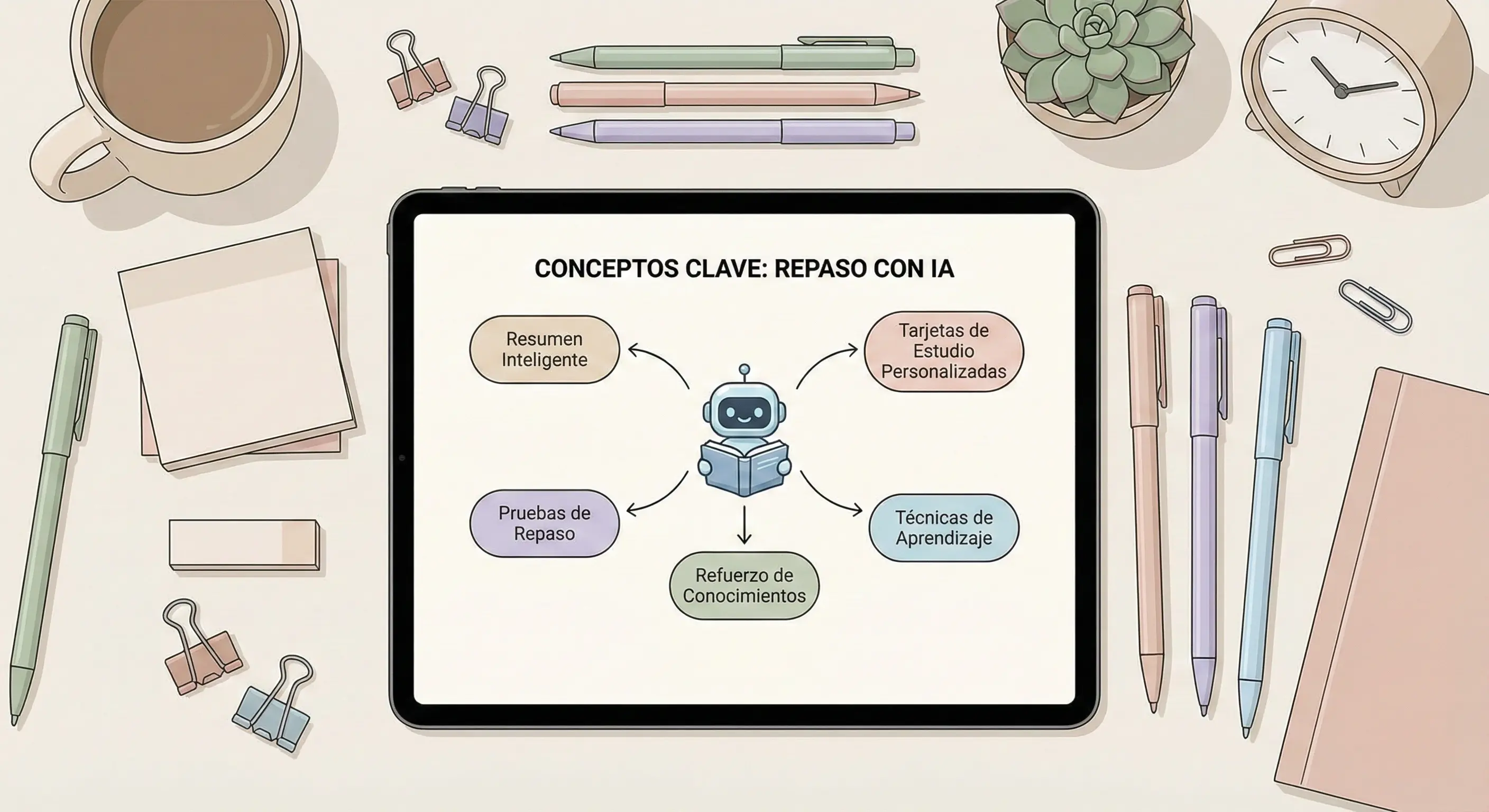
Just a few years ago, artificial intelligence seemed like science fiction. Today, in 2026, it has become an everyday tool that is changing how we study: tools like ChatGPT, Claude, or Gemini have put a tutor available 24/7 within reach of any student.
The problem is that most people use it badly. Asking it to summarize the topic and then reading the summary is exactly the same passive studying as always, only faster. The key is not copying answers, but using AI to test you. In this guide we explain how to do it effectively and ethically.
Key takeaways
- AI only improves your study if it asks you questions, not if it hands you answers.
- Working from your own notes prevents invented content.
- A good prompt demands context, correction, and no early solutions.
- Always verify against the official syllabus.
Why is AI a good ally for students?
The main advantage of artificial intelligence for students is immediate personalization. An AI for studying adapts explanations, examples, and exercises to your level, and rephrases a complex concept as many times as needed until it clicks. Add to that its constant availability: no schedules, no office hours.
It also makes it easy to create practice material fast: tests based on your notes, questions adapted to your mistakes, cards ready to review. All of that reduces academic stress, because you get immediate feedback and a much clearer idea of where you stand.
But let's say it up front: AI does not learn for you. It is a coach, not a substitute for the training.
The best AI tools for students in 2026
ChatGPT and Claude: conversational tutors
These AIs work as virtual tutors. Used well, they serve to:
- Explain difficult concepts step by step
- Resolve specific doubts on the spot
- Listen to your explanation and spot where it is weak
That said: they should not be your primary source of content, but a support layer on the material you already have.
Perplexity: fast research with sources
Perplexity stands out because it cites sources, which makes it useful for:
- Verifying information
- Finding explanations with scientific backing
- Expanding on specific concepts
It is especially handy when you need to confirm a fact or a definition.
Selectiva.app: applied study techniques
Selectiva.app works exclusively with your notes, which is the key difference when you need to study exactly what will be on the exam. It lets you apply active recall, personalized tests, summaries, outlines, and spaced repetition to your own material.
How to get AI to ask you questions
Passive reading is not enough. Learning research shows that active techniques improve long-term retention, and this is where AI makes a difference: it can test you, spot gaps, and adapt questions to your level.
Active recall: why it beats rereading
Active recall consists of trying to remember information without having it in front of you, forcing your brain to retrieve it from memory. That cognitive effort is what strengthens the connections associated with learning.
The brain learns best when it makes a mistake, receives a correction, and tries again: that sequence leaves a far more solid trace than passive reading.
👉 You can learn more about this technique in our article on active recall.
Effective prompts to make AI examine you
Chat tools become examiners if you know how to ask. The key is to give context and demand correction:
Act as a university professor. Examine me on Topic X with multiple-choice and essay
questions. Do not give me the answers until I respond. Correct my mistakes and explain
why they are wrong.
Simple, yet very powerful.
Step by step: how to create quizzes from your notes with AI
This is where specialized tools really make a difference. It is not just about generating questions, but doing it from the exact content that will be on your exam.
Selectiva.app is designed for studying directly from your own notes, avoiding the biggest problem with generalist AI: invented or off-syllabus content.
- Turn notes and PDFs into quizzes: upload the material in any format and the AI generates questions matched exactly to that content.
- Build outlines from your syllabus: it detects key concepts and the relationships between them, so you see the whole topic at a glance.
- Schedule your reviews: it applies spaced repetition so each piece of content comes back right before you forget it.
The complete method to study with AI
- Organize the syllabus. Share the topics, the exam date, and your circumstances: hours available per day, days per week, and your level in each block. With that it can build a realistic schedule.
- Summarize key concepts. Ask it to extract the main ideas and essential definitions from each topic, so you know where to focus.
- Practise with questions. Have it act as an exam generator: tests, case studies, and flashcards, with immediate correction and an explanation of the error.
- Review based on your mistakes. Ask for a plan focused on where you failed. That way you stop reviewing what you already master.
Advanced strategies
The Feynman technique with AI
It consists of explaining a concept as if you were teaching it to a child, which forces you to simplify. An AI can act as a critical listener: it detects gaps and inconsistencies in your explanation and asks precisely about what you dodged.
Summaries that actually work
Not all summaries are equal. Good ones remove redundancy, keep the logical structure, and preserve the concepts you will be evaluated on. Then turn them into tests: a summary that does not end in questions is passive material.
Risks when studying with AI
AI can invent facts, oversimplify, and confuse similar concepts. And it does so in the same confident tone it uses when it is right, which is exactly what makes it dangerous when you are studying something you do not yet master.
How to protect yourself:
- Always cross-check against your subject's official syllabus.
- Use academic sources for anything you plan to memorize.
- Never memorize something you do not understand.
AI is a support, not an absolute authority.
Conclusion: start studying better with AI today
Artificial intelligence does not replace studying, but used well it amplifies it. The best AI tools for studying do not just organize your time or summarize content: they ask you questions, create personalized tests, and expose your gaps.
Start today with three rules: use your own notes, practise with questions, and learn from your mistakes.
AI does not study for you. But it can help you study much better.
Frequently asked questions
Can you study using only ChatGPT?
It is not advisable as your single source: it can invent facts or drift off-syllabus. Use it to explain and to test you on material you have already verified.
How do I get AI to ask me exam questions?
Give it context (subject and level), ask for multiple-choice and essay questions, and require that it withholds the answer until you respond and then corrects you with an explanation.
Is studying with artificial intelligence cheating?
No, as long as you use it to practise and understand. It stops being studying when you hand in work the AI wrote as if it were yours.
Which AI is best for turning notes into quizzes?
Tools that work only from your material, such as Selectiva.app, because they generate questions tied to your syllabus and add nothing invented.
Study better with your own notes
Upload your PDFs and Selectiva turns them into summaries, quizzes and flashcards in seconds.