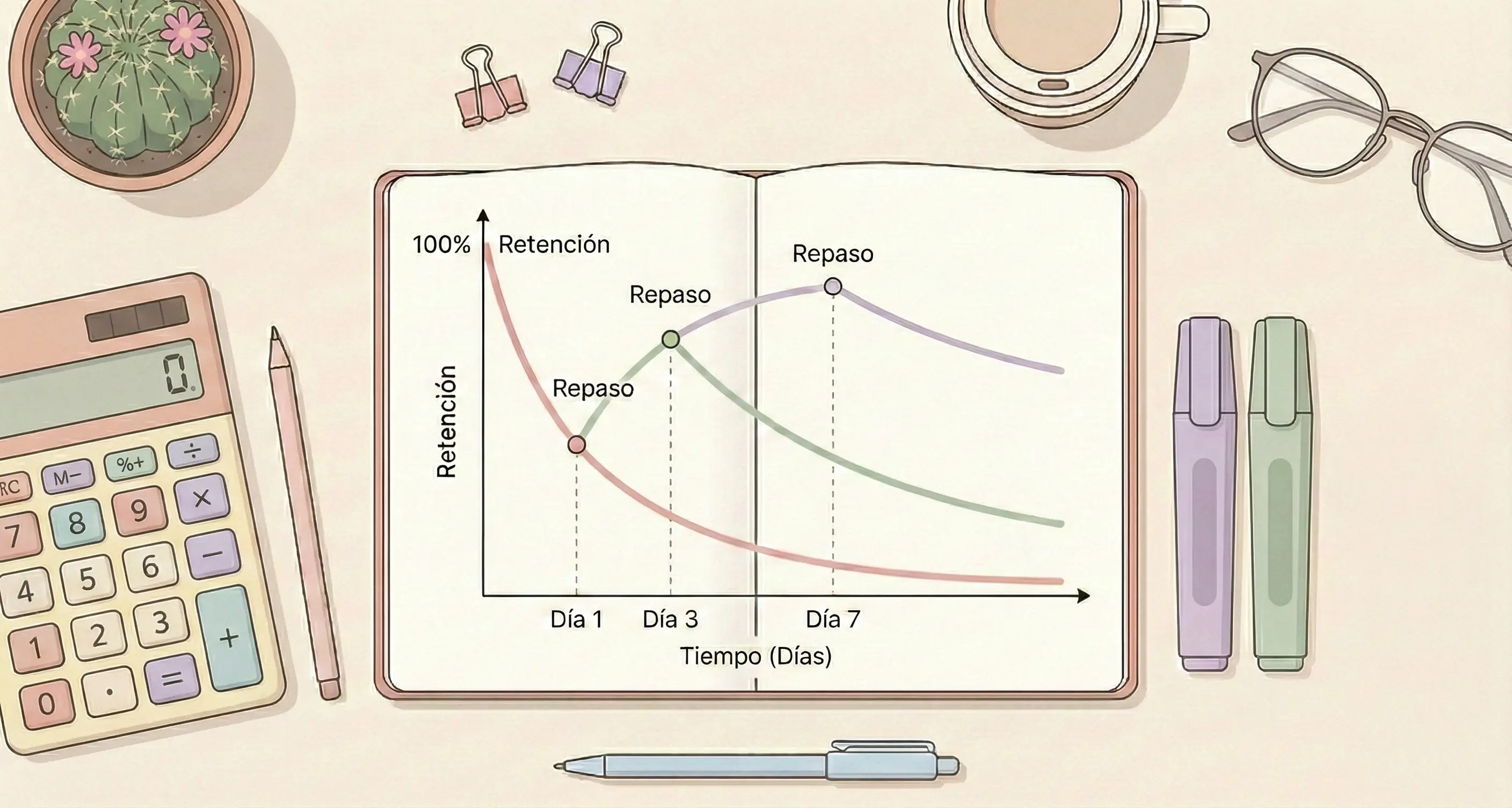
Studying and forgetting quickly doesn't mean you have a bad memory; it's the forgetting curve, a natural phenomenon that causes our brains to lose information if we don't review it. This affects every student, regardless of age or academic level. What you learn today can disappear tomorrow if you don't take action.
How does memory work?
Memory doesn't function like a static file, but rather as an active process that goes through three phases: encoding, consolidation, and retrieval. When we learn, information is transformed into networks of connections between neurons; if these connections are not reactivated, the brain weakens and eliminates them to save energy, which manifests as forgetting. For a memory to last, it needs repetition and time, as this strengthens synapses through long-term potentiation and consolidation during sleep, especially in deep phases. Remembering is not about recognizing, but reactivating those neural networks, which is why trying to retrieve information without looking at notes is much more effective than rereading. Forgetting, far from being a failure, is a normal biological mechanism, but it can be slowed down very effectively if studied in a spaced, active, and consistent manner, respecting how the brain actually works.
Strategies that really work
- Spaced repetition. Studying everything all at once is a bad idea. Learning is much more effective when spread out over time: today, tomorrow, in a few days, and a week later. Each review reinforces memory and slows down forgetting, making the information last longer.
- Active recall. Reading and rereading notes gives a false sense of mastery. To truly learn, you must try to remember without help. Asking yourself questions and answering them from memory strengthens neural connections and consolidates knowledge better than simply recognizing information in a text.
- Interleaving. Always studying a single topic in a row is comfortable but ineffective. Mixing subjects or types of exercises within the same session forces the brain to identify which knowledge to use at any given moment, improving understanding and the ability to apply what has been learned in new situations.
- Avoid Cramming. Studying many hours straight right before an exam may work in the short term, but the content fades quickly. Lasting learning doesn't depend on occasional intensity, but on regularity and the use of appropriate strategies.
How technology can facilitate study
Technology can be a distraction or an ally, depending on how it is used. Today, there are applications specifically designed to study better, not harder, automatically applying scientific principles on how memory works.
Selectiva App is a good example of this approach. The app organizes study sessions by taking the forgetting curve into account and frees the student from the heaviest part: deciding when and how to review each piece of content. Key features include:
- Smart reminders, which indicate the ideal time to review each topic.
- Quizzes and flashcards, which encourage active recall.
- Conversion of notes into tests, automatically transforming passive material into practical exercises.
Practical plan to combat the forgetting curve
Initial phase (Day 0)
Study the material carefully and transform the information into active material: flashcards, questions, or short quizzes. This step is key because it turns passive study into real learning.
First reinforcement (After 24 hours)
Perform a quick review using short questions or a quiz. The goal is not to memorize more, but to prevent the sharp drop in memory that occurs on the first day.
Second reinforcement (After 3 days)
Revisit the content, mixing it with other topics. This review helps consolidate information and improves the ability to relate concepts.
Third reinforcement (After 1 week)
Take a brief test without any aids. If you can remember the information with some ease, it means the knowledge is beginning to stabilize.
Final consolidation (After 1 month)
Perform a global review of the content. At this point, the information has moved into long-term memory and only needs occasional maintenance.
Conclusions
Forgetting is part of the normal functioning of the brain, but it is not uncontrollable. You don't need an exceptional memory, but rather a well-designed study system. When science-based strategies are applied and consistent habits are maintained, each review becomes more effective and learning stops being fleeting to become lasting knowledge.